Home › Industrial and Heavy-Duty Asphalt Paving
Handle heavy traffic with confidence using industrial asphalt paving in Mesquite, TX. We build thick section pavements for truck yards, loading docks, and warehouse facilities designed to resist rutting and premature failure.
Precision Asphalt Mesquite provides professional industrial asphalt paving throughout Mesquite, TX, Texas and the surrounding area. Our licensed, insured crew delivers safe, clean, on-time work with a free estimate before anything begins. Call (972) 362-9038 or request your free quote.
Industrial Asphalt Paving Built for Mesquite Worksites
Precision Asphalt Mesquite focuses on industrial asphalt paving that can handle real abuse from trucks, forklifts, and 24/7 operations. We work across Mesquite and East Dallas on facilities that see heavy wheel loads, tight turning radii, and constant braking and oil spills. That includes trucking yards, warehouse aprons, loading docks, plant entrances, and equipment storage areas.
Our approach is simple but disciplined. We start with intended traffic and load ratings, then design a pavement section that works for your specific use instead of using a one-size-fits-all thickness. A distribution yard with 80,000 lb tractor trailers needs a different build than a light industrial flex space. Before we give you a number, we look at access points, turning paths, drainage, and how your operation actually flows day to day.
Because we live and work here, we account for Mesquite’s swelling clay soils, hot summers, and occasional hard winter cold snaps. Those conditions can tear up a poorly designed pavement in a few years. Our industrial asphalt paving is built to flex with the soil, shed stormwater away from your building and docks, and survive both August heat and January freeze-thaw cycles.
How We Design Heavy-Duty Asphalt for Mesquite Facilities
For industrial asphalt paving, design matters more than anything you can see on the surface. Precision Asphalt Mesquite begins with a site walk where we look at soil type, existing failures, truck paths, and drainage patterns. In much of Mesquite the native soil is expansive clay, so we often recommend undercutting weak areas or stabilizing the subgrade with lime or cement to keep it from pumping and rutting under trucks.
Next we size the pavement section. A typical heavy-duty layout in this area often includes 6 to 10 inches of compacted crushed limestone base and 3 to 5 inches of industrial-grade hot mix asphalt in multiple lifts. For very heavy traffic like cross-dock facilities or container yards, we may recommend thicker base, thicker asphalt, or a combination of heavy-duty asphalt and reinforced concrete in the tightest turn and braking zones.
We also consider your drainage and run-off requirements. Mesquite storms can drop several inches of rain in a short time. If water ponds on an industrial pavement, it will break down the surface, soften the base, and shorten the life of the entire section. We build proper slopes, design swales or inlets where needed, and align pavement elevations with your dock doors and thresholds so water runs away from the building instead of toward it.
Our Step-by-Step Industrial Paving Process
When you hire Precision Asphalt Mesquite for industrial asphalt paving, you get a clear sequence of work so your operations team knows what to expect.
1) Investigation and layout. We locate underground utilities, evaluate the existing pavement or soil, confirm traffic counts, and map turning paths and loading zones. At active sites we coordinate phasing so you can keep at least some truck access while work is in progress.
2) Demolition and excavation. We remove failing asphalt or concrete, haul debris off site, and cut down to the design subgrade. Soft or pumping areas are undercut and replaced with suitable structural fill.
3) Subgrade prep and stabilization. The exposed soil is graded for drainage and compacted to project specifications. In problem clay areas, we often treat the subgrade with lime or cement to reduce plasticity and improve long-term stability.
4) Base installation. We install crushed aggregate base in lifts, moisture condition it, and compact each lift to density. Proper base work is what keeps heavy truck routes from settling, so we spend real time here instead of rushing to get to the blacktop.
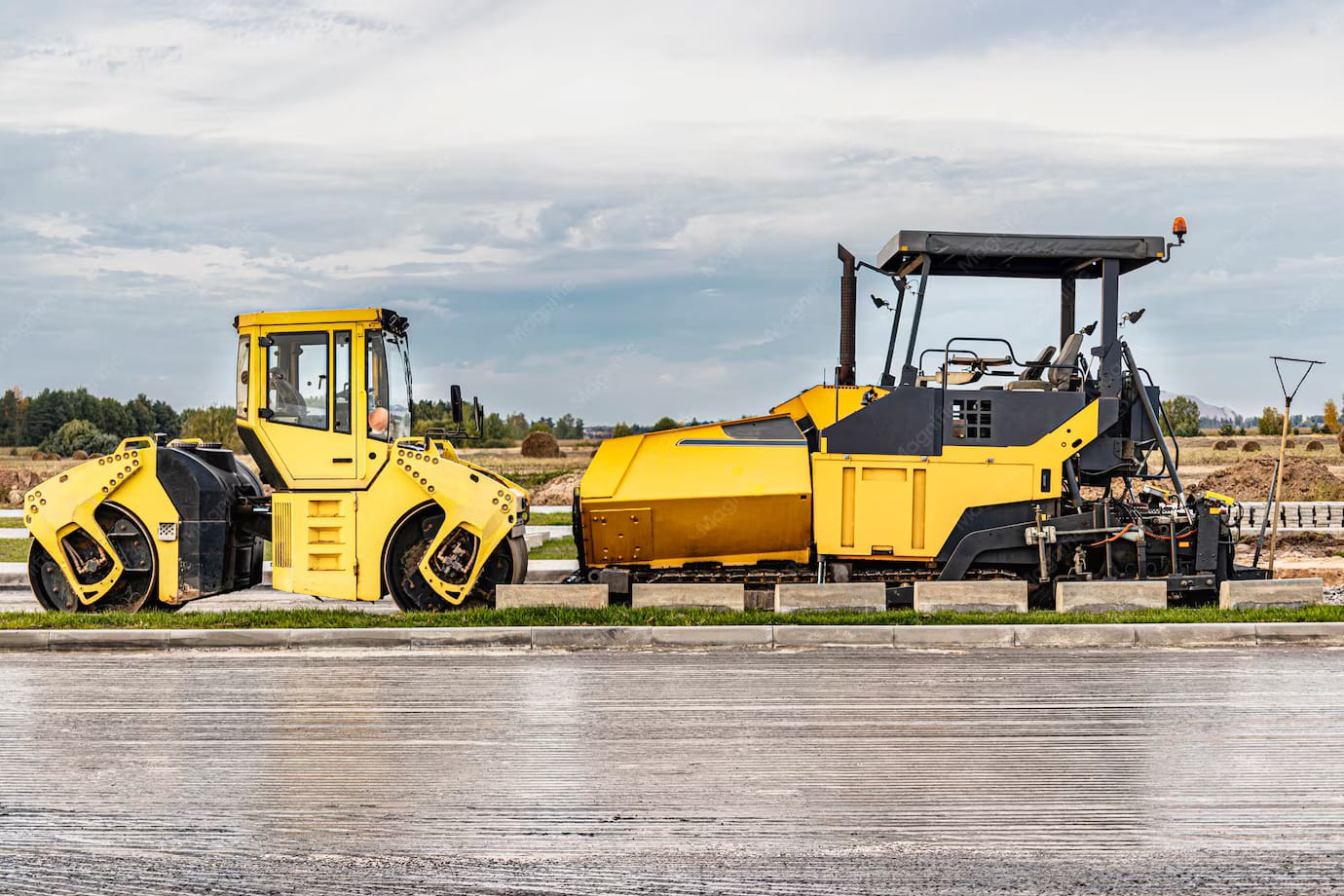
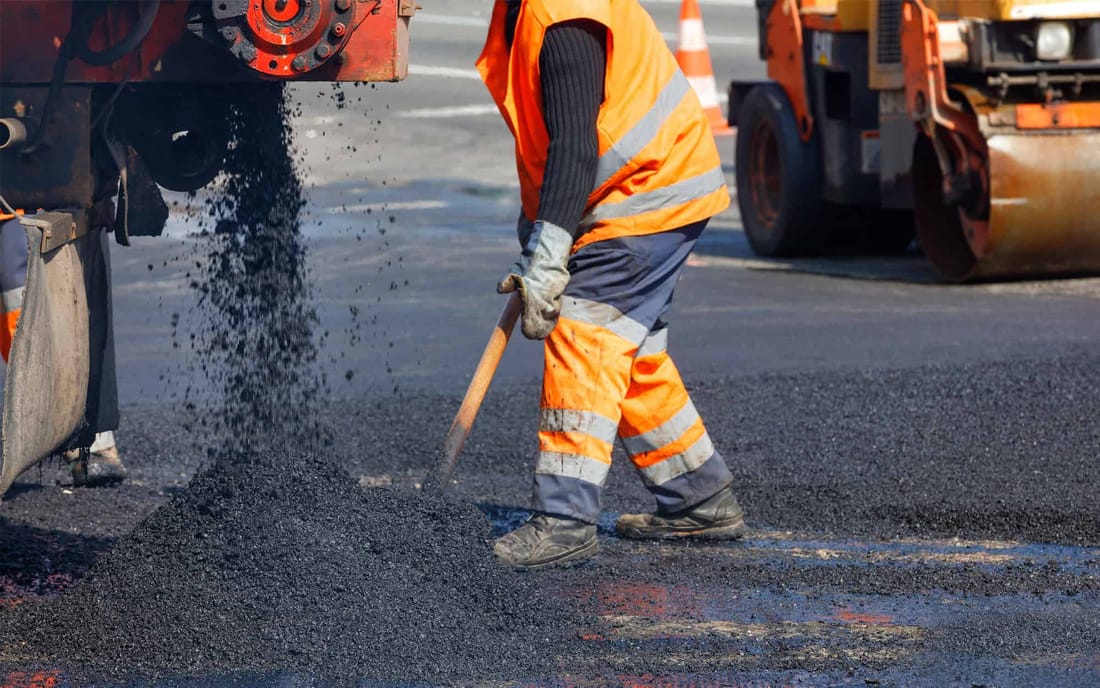
5) Asphalt placement. Industrial asphalt is placed in at least two lifts, usually a structural base course followed by a surface course. We keep mat temperatures within spec, use steel drum and pneumatic rollers in sequence, and watch joints carefully since those are where early failures usually occur.
6) Striping and final details. Once cool, we add truck stall markings, dock bay numbers, fire lanes, and any specialty markings your safety team requires. If needed, we install wheel stops, bollards, or concrete pads in high-load locations.
You end up with a pavement system built for the real loads it will see, not just a thin layer of blacktop spread over whatever was already there.
Material Options for Heavy-Duty Asphalt Surfaces
Industrial asphalt paving is not just “asphalt is asphalt.” For Mesquite facilities we select specific mixes that match your use and budget.
For base lifts we typically use a coarser, high-stability hot mix that handles heavy loads without shoving. The larger stone size gives the pavement structure and reduces rutting under slow-moving trucks. For the surface lift, we usually use a tighter, finer mix that resists fuel spills and provides a smoother ride for forklifts and pallet jacks.
In high oil and fuel exposure zones, like around fueling islands or near dock doors where trucks idle, we may suggest a polymer-modified surface mix that resists softening in summer heat. Around dumpster pads, compactors, and cranes, we often recommend a concrete pad tied into the asphalt so point loads do not punch through the surface.
We also think about noise and dust. If your site is near residential areas of Mesquite, a properly compacted and smooth asphalt surface can reduce truck vibration and rattling. If you have outdoor storage yards where dust is an issue, a heavier asphalt section over properly compacted base will keep fines locked in and reduce maintenance on your equipment and inventory.
What Drives Cost on Industrial Asphalt Paving Projects
Business owners often want to know why industrial asphalt paving costs what it does. The three biggest drivers are thickness, base work, and site constraints.
Thickness is directly tied to your traffic. A light 2 inch overlay might be fine for car parking, but for heavy truck lanes around Mesquite distribution centers we are typically in the 3 to 5 inch range over a robust base. More asphalt and more base means more material and trucking.
Base work is the hidden cost that usually separates a cheap bid from a good one. If your existing pavement is alligator cracked or holding water, simply paving over it is not a solution. We may need to undercut soft spots, add stabilization, and install more aggregate base. That costs more up front but dramatically extends pavement life.
Site constraints also matter. Tight sites near LBJ Freeway or older industrial parks off Gross Road can make access and phasing more complicated. Working around active dock doors, tight turnarounds, or limited staging areas requires extra labor and mobilizations. We lay this out clearly in our proposals so you understand where every dollar is going.
We can often present a phased plan that spreads work and cost over more than one budget cycle. For example, we might reconstruct the worst truck lanes and dock aprons now, then plan a mill and overlay of the lighter traffic areas next year.
Common Industrial Pavement Problems and How We Prevent Them
Heavy-duty asphalt in Mesquite faces specific challenges, and knowing what typically goes wrong helps us design against those failures.
Rutting and shoving in truck lanes usually comes from insufficient base thickness, poor compaction, or a mix that is too soft for the loads and heat. We counter this with thicker bases, strict compaction testing, and high-stability mixes that hold their shape even in August.
Alligator cracking and potholes often start where water gets into the base layer. That is why we focus on proper slope, tight joints, and sealed edges. On sites where drainage cannot be regraded easily, we may add inlets, valley gutters, or strategic trench drains to pull water away from wheel paths.
Edge failures are common along shoulders where trucks drive off the pavement edge or where the asphalt was left unsupported. We design wider structural lanes in heavy-traffic zones and recommend proper edge support or tie-ins rather than leaving a thin lip that will crumble.
Fuel and oil damage is another concern at industrial sites. We recommend regular sweeping and a maintenance plan that includes periodic crack sealing and, when appropriate, sealcoating of lighter duty areas. During our walkthroughs, we flag the highest risk locations and either reinforce them or suggest concrete transitions so that routine operations do not constantly eat away at your pavement.
Planning, Scheduling, and Working Around Your Operations
For industrial asphalt paving to succeed, it has to fit your production and shipping schedule. Precision Asphalt Mesquite coordinates closely with your operations or property management team so the project does not bring your yard to a halt.
We often break projects into phases, keeping at least one truck lane and a portion of your docks open at all times. On some Mesquite sites we work evenings or weekends for key steps such as asphalt placement in front of primary dock doors, then reopen lanes once the pavement has cooled and passed a quick inspection.
Before work begins, we provide a simple site plan with barricade locations, temporary traffic patterns, and clear signage. Your drivers and vendors know exactly which areas are closed and when. We also plan deliveries and material staging so they do not block fire lanes or critical access points.
If you are dealing with city inspections or need to coordinate with Mesquite code or fire officials, we help line up any pavement-related requirements such as fire lane widths and striping details. The goal is a finished industrial pavement that not only holds up under heavy use but also keeps your site compliant, safe, and efficient for the long term.